
I arrive through Takanawa Gateway Station, and the station is already performing before I even know what I think about it. The station and roof, designed by Kengo Kuma, spread overhead in pale timber ribs, ending in small tower-like volumes with cafés overlooking the platforms almost like observation points. It feels a bit like an abstract forest translated into structural rhythm and held together with steel precision. The space is open, luminous, carefully resolved. Yet what marks the experience most strongly is not the timber canopy but the sound. The music is loud. It does not accompany movement; it pushes it forward. The station does not function as neutral infrastructure. Wooden service robots stand near the gates, polished and rounded, reassuring in their material yet entirely digital in operation. The gesture is clear: automation softened through organic surface. Technology becomes aesthetic.
Crossing from the station into the Takanawa Gateway City Newoman complex, initiated by East Japan Railway Company and part of a larger mixed-use redevelopment that also includes installations by artists such as Emmanuelle Moureaux, does not feel like moving from transport into a neighborhood. It feels more like entering the next scene of a controlled composition. The district appears almost all at once, as if unrolled from a master plan and installed at scale. At the same time it is clearly not finished. Shop names printed on A4 sheets sit under transparent plastic covers. Temporary and rather cheap looking signs suggest short-term uses, maybe also because it is still unclear which tenants will actually manage to pay the high rents here.
Flowers line the walkways in expensive arrangements. Indoor spaces include long wooden benches, raised boxes filled with walnut shells (for room climate? for play? or simply decorative?), vertical greenery behind glass, and drum-like structures attached to the ceiling. Nature is pruned, framed, miniaturized. What appears organic is actually carefully installed. There is little unpredictability, little decay, and hardly any seasonality beyond controlled blooming cycles.

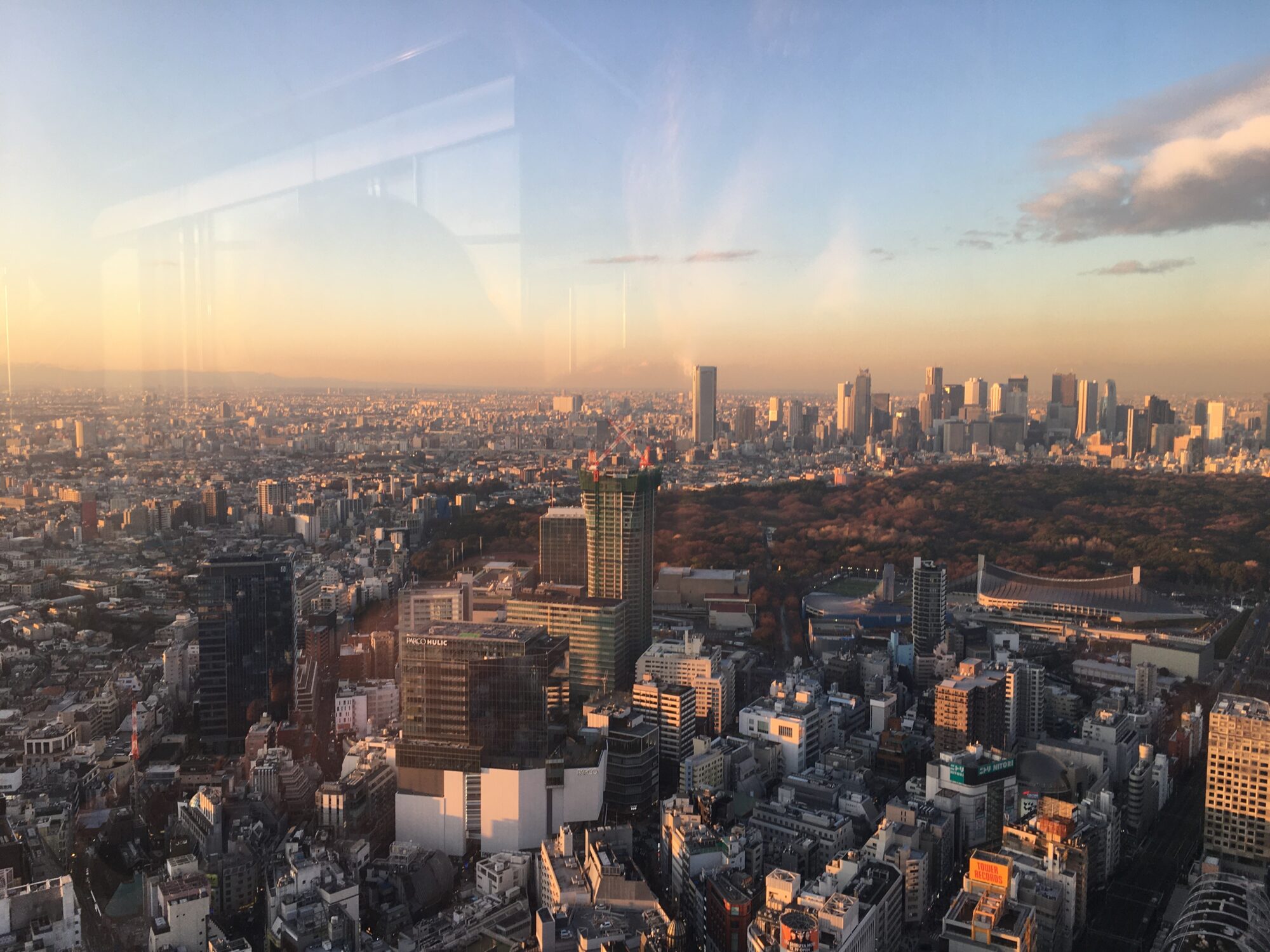
Movement through the district is guided with precision. On the twenty-eighth floor a space branded “Luftbaum” opens and the city slowly disappears into abstraction below. Sakura trees bloom in contained installations. Water moves through narrow channels. Tatami mats interrupt engineered stone floors and hint at domestic grounding. Through the glass Tokyo becomes grey density. Above, the roof is open, yet temperature and humidity still feel strangely moderated. The loudness of the station below is replaced by managed calm. The complex works almost like a single orchestrated environment that changes intensity as one moves up.

The forest is convincing exactly because it is constructed. Wooden cocoons built by artists offer small enclosures within the spectacle, promising intimacy without really leaving the branded environment. One can sit on tatami, touch timber, listen to controlled water, and still remain fully inside a consumption infrastructure, next to churchlike cafés and high-end restaurants. The forest does not resist the building. It confirms it. Nature here does not interrupt capital flow. It supports it.

This vertical relocation of landscape is sociologically quite telling. Historically parks functioned as urban commons, spaces where different social groups could encounter each other with only limited economic filtering. At Takanawa Gateway City greenery is lifted upward, curated, and embedded inside a mixed-use complex oriented toward high-value tenants and consumers. Access is technically open, but the atmosphere quietly codes belonging. Prices in cafés, aesthetic signals in restaurants, and the polished neutrality of co-working interiors all suggest a very specific user.
The ordinary becomes exclusive. Desk space, coffee, greenery, silence are packaged as privilege. The extraordinary becomes routine. What once signaled exception now appears as baseline quality in global luxury urbanism. The vocabulary is clearly transnational. Similar spatial grammars appear in Singapore, Dubai, or London: mixed-use density, vertical greenery, experiential retail, cultural branding.
The project also does not hide its orientation toward symbolic economy. The announcement of a future “Museum of Narratives” planned to open in March 2026 makes this quite explicit. Storytelling becomes infrastructure. Identity becomes something the district actively produces. Timber ribs, wooden robots, walnut shells, sakura installations, and curated gastronomy align within a script of sustainable futurity and refined modernity. Technology and tradition seem reconciled, at least on the level of surfaces.
Many questions stay unanswered: If this is presented as a model for future urban development in Tokyo, then one has to ask quite simply: who is this built for and why? Who will really use it and how? What alternative models we can promote instead as it should be a city for all?